Costs
Co-packing or self-manufacturing in the US, compared on cost and capacity
Co-packing vs self-manufacturing in the US: what co-packer minimums, run sizes, kitchen buildout costs, state loans and regional rates really look like.
What to take away
- Co-packing vs self-manufacturing in the US usually comes down to cash timing: a co-packer sells you capacity by the run, while self-manufacturing sells you capacity by the square foot.
- Co-packing buys a licensed plant, the packer's FDA facility registration and a scheduled process already filed for acidified sauce. Self-manufacturing costs less per bottle at volume and far more before the first sale.
- The real fork is not unit cost. It is whether you can sell a full minimum run before the sauce fades.
- Below roughly 300 to 500 cases a year, a typical range, renting commercial kitchen time beats both routes for a US startup.
- Co-packer minimum order quantities in sauce and condiment work commonly land somewhere between 100 and 1,000 cases per run, with 300 to 500 cases a common starting gate.
- A licensed kitchen buildout typically costs $30,000 to $120,000 in leased space and $150,000 to $500,000 for a dedicated plant, before equipment at $25,000 to $150,000, permits and working capital are counted.
- SBA 7(a), 504 and microloan programs can fund either route, and state departments of agriculture often add their own food business loan or grant money.
- Regional manufacturing costs differ enough that the same sauce can cost noticeably more to make in California or New York than in Texas, Louisiana or the upper Midwest. Industrial rent alone runs about $6 to $12 per square foot a year in Texas and Louisiana, against $20 to $40 in coastal California and the New York metro.
- Capacity and control trade in opposite directions over three years: co-packing buys speed and compliance, self-manufacturing buys margin and recipe control.
- Self-manufacturing usually beats co-packing on unit cost only above roughly 5,000 to 10,000 cases a year, or about 100 to 200 cases a week.
What co-packing and self-manufacturing each include in the US
Co-packing means a licensed facility makes your sauce on its equipment, under its food safety plan, and bills you per run. You supply the recipe, the packaging spec and the purchase order. The co-packer supplies the FDA-registered plant, the process authority sign-off, the batch records and the labor.
What you buy is a licensed plant, the packer's FDA facility registration and a scheduled process filed for acidified sauce under 21 CFR Part 114. The formula stays yours. The filing covers the packer's line, so a move in-house later means filing the scheduled process again from scratch.
Self-manufacturing means you hold the facility. That can be a leased commercial kitchen, a shared incubator space, or a building you fit out. You carry the FDA Food Facility Registration, the state food processing license, the ServSafe or state food handler certification for staff, and the liability insurance.
Per bottle it costs less than co-packing at volume. Before the first sale it costs far more.
Below roughly 300 to 500 cases a year, a typical range, neither route pays. Rented commercial kitchen time beats co-packing and self-manufacturing both: you pay by the hour, keep the recipe, and sell the batch before you sign a run or a lease.
Both routes sit under the same federal rules. FDA handles food labeling, facility registration and FSMA preventive controls. USDA matters if you claim organic or source agricultural inputs under the National Organic Program. State departments of agriculture issue processing licenses and farmers market permits.
Cottage food laws are the third path, and they are state by state. They let home producers sell shelf-stable sauces and condiments in limited channels, usually direct to consumer or at farmers markets within the state. They do not support retail distribution or interstate shipping.
Most founders move through the sequence rather than choosing once. Cottage or incubator production proves the recipe. A co-packer scales it. Self-manufacturing arrives when volume makes the lease cheaper than the run fee. That progression is the spine of most co-packing vs self-manufacturing hot sauce decisions.
One more shared cost: product identification. Retail needs GS1 US barcodes, and both routes pay for them. Neither route avoids label review, nutrition analysis or a process authority letter for acidified sauces.
Co-packer minimums, run sizes and changeover costs compared
A co-packer minimum order is the smallest run the plant will schedule. In sauce and condiment work, that is often expressed in cases, sometimes in gallons or in full production hours. The number exists because changeover, sanitation and line time cost the same whether you make 200 cases or 2,000.
Co-packer minimum order sizes
- Small sauce run100-1,000 cases
- Many plants open300-500 cases
- Some plantsfull shift only
Typical starting minimums for a small sauce run land between 100 and 1,000 cases. Many plants open at 300 to 500 cases. Some will not quote below a full shift. A few specialty plants run smaller pilot batches at a premium.
The work spreads across high-acid bottling plants that also fill salsa, barbecue sauce and marinade, dedicated sauce plants, and small pilot plants.
Published minimums move with the season, the line and the plant's order book. Ask each plant for its current minimum in writing before you compare quotes.
Run size comparison is not just about the minimum. It is about the next step up. Plants usually price in tiers, and the per-unit cost drops as the run grows. The gap between a 500-case run and a 2,000-case run can be substantial per jar.
As an illustration, a plant quoting about $40 per case of 12 at a 500-case run might quote about $26 to $30 per case at 2,000 cases.
As totals, ignoring freight, 500 cases at $40 is $20,000 for 6,000 bottles, or about $3.33 a bottle. A 2,000-case run at $28 is $56,000 for 24,000 bottles, or about $2.33 a bottle. Committing to the larger run cuts the per-bottle price by roughly a third.
The same changeover, sanitation and line time spread across four times the volume. Treat the spread as a shape, not a benchmark, because your jar size, ingredients, label count and plant schedule set the real number.
Changeover costs are the hidden line. Allergen cleanouts, kosher or organic segregation, label changes and flavor switches all add time. A plant running one SKU on a long run charges you less than a plant stopping the line for your 400-case batch.
Typical co-packer pattern
- First cash out
- Minimum run plus ingredients and labels
- Unit cost at low volume
- High, because changeover is spread thin
- Unit cost at high volume
- Falls with run size
- Lead time
- Weeks to months, set by plant schedule
- Regulatory duty
- Packer holds the registration, the filing and the records
- Recipe control
- Negotiated, plant process rules apply
- Compliance burden
- Mostly the plant's
- If it fails
- You lose the run
Typical self-manufacturing pattern
- First cash out
- Buildout, equipment, permits, insurance
- Unit cost at low volume
- Very high, because fixed costs sit on few units
- Unit cost at high volume
- Falls as you fill your own hours
- Lead time
- Set by your own capacity
- Regulatory duty
- You register, file and keep daily monitoring records
- Recipe control
- Yours, within your food safety plan
- Compliance burden
- Entirely yours
- If it fails
- You lose the lease and the equipment
Ingredient sourcing changes the math too. Co-packers often buy through their own approved suppliers, which can be cheaper per pound but locks your spec. Buying your own peppers, vinegar and spices gives control and sometimes better quality, but you carry the inventory and the freight.
Freight is easy to forget. Shipping ingredients to a distant plant and finished cases back to a warehouse adds cost that a local kitchen does not carry. That single line often decides the comparison for a founder in a state with few co-packers.
If you want the full cost anatomy before you negotiate, the breakdown in this hot sauce production costs guide is worth reading alongside a co-packer quote.
Building or leasing your own kitchen: equipment, licensing and buildout
Kitchen buildout cost is where self-manufacturing gets serious. A leased commercial kitchen needs three-compartment sinks, hand sinks, washable floors and walls, ventilation, refrigeration and a licensed water supply. A dedicated sauce plant adds kettles, mixers, fillers, cappers, labelers and a packaging area.
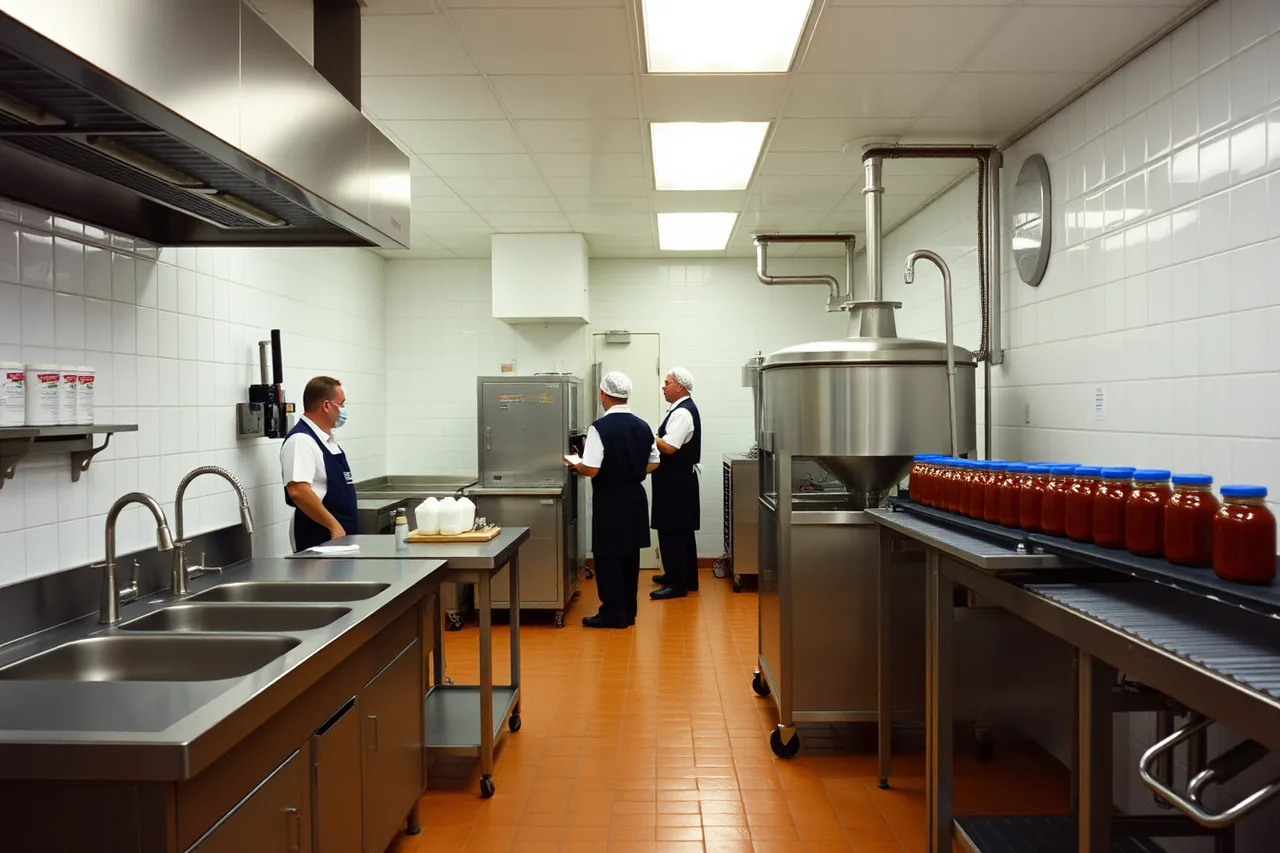
Typical figures, and they vary by state and equipment spec. Shared kitchen hours rent for about $20 to $60 an hour. A fit-out of leased commercial space runs roughly $30,000 to $120,000. A dedicated small sauce plant buildout runs roughly $150,000 to $500,000.
Equipment adds $25,000 to $150,000 depending on how much of filling and labeling is automated. A used three-compartment sink, kettle and manual filler can be found for a few thousand dollars. A new steam kettle, semi-automatic filler, capper and labeler commonly total $20,000 to $60,000.
Leasing into an existing shared kitchen is the cheapest entry. You rent hours, use their licenses and equipment, and keep your own recipe. The trade-off is scheduling, and the fact that you cannot run a retail distribution volume on rented hours.
Building out your own space means permits, inspections and a landlord willing to host food manufacturing. Expect plan review, a state processing license, a local health inspection and an FDA Food Facility Registration before the first sale. Insurance and workers compensation follow.
Equipment is the other half. A small kettle and a manual filler can start a sauce line. A semi-automatic filler, a steam kettle and a labeler move you into real volume. Each purchase should be judged against the volume it earns, which is the argument in this hot sauce production costs reviews piece.
Licensing costs are modest next to buildout, but they are not zero. State processing licenses, local permits, ServSafe certification for each handler, and label or process authority review all add up. Budget them as a fixed package rather than as surprises.
Typical figures: a state food processing license runs about $100 to $1,000 a year, and local permits add $100 to $1,000. ServSafe certification costs about $150 to $250 per person.
A process authority letter for an acidified sauce runs $500 to $2,000, and a nutrition panel or label review runs $300 to $1,000 per SKU. FDA Food Facility Registration itself has no fee, but product liability insurance for a small sauce producer typically runs $500 to $3,000 a year.
Labor is the recurring cost people underestimate. Sauce production is not fully automated at small scale. Filling, capping, labeling and packing cases are hours of work. At low volume, your own unpaid hours hide that cost. At higher volume, payroll and turnover show up.
- Confirm your state processing license and local health permit requirements
- Check whether your space is zoned for food manufacturing
- Get a process authority review for acidified or low-acid sauces
- Register the facility with FDA before producing for sale
- Price three-compartment sinks, kettles, filler, capper and labeler
- Certify every handler through ServSafe or your state equivalent
- Line up product liability insurance and a GS1 US barcode account
The BLS publishes business cost data for food manufacturers that helps you compare what co-packing versus self-manufacturing actually costs per unit. Use it to sanity-check any quote before you sign a lease.
State food business loans and SBA programs that fund either route
State food business loans vary widely, and the best place to start is your state department of agriculture. Several states run agriculture or food processing loan funds, grant programs or cost-share schemes aimed at value-added producers. Terms are usually better than bank rates because the goal is in-state processing capacity.
Named examples include the Louisiana Agricultural Finance Authority, the Michigan Good Food Fund, the Illinois Farm Development Authority and Vermont's Working Lands Enterprise Initiative. Ohio's Ag-LINK program reduces the interest rate on agricultural operating loans.
USDA Rural Development's Value-Added Producer Grant funds value-added food businesses, typically up to $75,000 for planning and up to $250,000 for working capital. Terms, deadlines and award sizes change, so confirm current details with the state agency or the program office.
Some states pair those funds with kitchen incubator programs, shared-use facilities or food hub grants. A few offer equipment financing or matching grants for small processors. Check the department of agriculture, the state economic development office and any state food council.
Federal money runs through the Small Business Administration. SBA 7(a) loan terms cover the general purpose option and can fund working capital, a co-packing run or a kitchen buildout. Rates and repayment are set by the lender within SBA limits.
The 7(a) maximum is $5 million. The rate is negotiated, capped at prime plus 2.25% to 2.75% depending on loan size, and typically lands near 10% to 13% all in.
SBA 504 loan terms are structured for fixed assets. That makes them a fit for equipment and facility financing, which is exactly what a self-manufacturing buildout needs. They are delivered through certified development companies.
The 504 maximum is $5.5 million, and the fixed debenture rate typically lands in the mid single digits to around 7%.
SBA microloan terms cover the small-scale route for startup sauce makers. Amounts are modest, which suits a first co-packed run or a deposit on shared kitchen hours. You apply through an intermediary lender rather than the SBA directly.
The microloan maximum is $50,000, the average loan is about $14,000, and rates typically run from about 8% to 13%.
To find one, use the official list of SBA microlenders. Many intermediaries work with food businesses and understand seasonal cash flow. Ask whether they have lent to food producers before.
A practical sequence: fund the first co-packed run with savings, a microloan or a state grant, then use 7(a) or 504 money for equipment and buildout.
Regional manufacturing cost differences across US production hubs
Regional manufacturing costs in the US are not uniform. Labor rates, electricity, water, commercial rent, freight distance and the density of available co-packers all shift the number. The same sauce spec can quote very differently in two states.
Typical figures: industrial space rents for about $6 to $12 per square foot a year across Texas, Louisiana and the Midwest, against $20 to $40 in coastal California and the New York metro.
Commercial electricity runs near 9 to 11 cents per kilowatt hour in Louisiana and Texas, against roughly 18 to 25 cents in California and New York. Production wages run near $16 to $20 an hour in the South and Midwest, against $20 to $26 in California and New York.
California has the deepest co-packer base and strong produce access, but high rent, high labor and strict local permits. It is fast to find a plant and slow to build one. Oregon is similar in produce quality with somewhat lower costs and a smaller plant network.
Texas offers lower rent, lower labor and a growing food manufacturing base, with strong logistics for national distribution. Louisiana has a long sauce and seasoning tradition, competitive co-packing capacity and good access to peppers and spices through Gulf ports.
New York has strong specialty food demand and incubator support, but high operating costs outside upstate. Illinois sits centrally for freight, with solid co-packing capacity around Chicago. Florida and Washington each combine produce access with distinct labor and seasonal cost patterns.
For a founder, the practical read is this: dense co-packer states are easier to start in, and cheap operating states are better to build in. If your volume is still small, pay the higher run cost near home. If you are building a plant, the regional spread in rent and labor can fund equipment over a few years.
Freight distance to your customers matters as much as production cost. A cheap run on the far coast can lose its advantage in shipping. Map your top five retail markets and pick the region that shortens the average haul.
Seasonality is regional too. Pepper harvests, produce pricing and plant schedules all vary by region and month. A plant in Louisiana may have different peak weeks than one in California. Book runs around those windows to avoid premium pricing.
Capacity, control and quality trade-offs over the first three years
Sauce production capacity is the variable that decides this choice, not ideology. Co-packing gives you access to capacity you could not build, but only in the sizes the plant sells. Self-manufacturing gives you flexible capacity, but only as much as you have funded.
In year one, control matters less than getting product on shelves. A co-packer brings compliance, consistency and a proven process. Most founders should take that trade.
In year two, the margin gap starts to bite. If your volume has grown, the per-unit co-packing cost stays roughly flat while your own plant's fixed costs spread across more units. That is the point where self-manufacturing math starts to work, and where a hot sauce production costs how to review helps you test the numbers.
For most sauce and condiment businesses, a staffed owned kitchen does not beat co-packing on unit cost until roughly 5,000 to 10,000 cases a year. That is about 100 to 200 cases a week of steady production.
Quality control cuts both ways. A good co-packer has tighter process control than a new founder with a rented kettle. A bad one will substitute ingredients, miss label specs or push your run for a bigger client. Vet the plant, visit it, and taste every batch.
Capacity risk is real. Co-packers drop small clients when a large one needs the line. That risk grows as you grow. Owning capacity removes it but adds the risk of idle equipment and fixed payroll in slow months.
By year three, many founders run a hybrid. They keep a co-packer for volume SKUs and use their own space for small-batch, limited or experimental products. That split preserves retail supply while keeping recipe control where it earns the most.
The sequence matters more than the choice. Prove demand, then buy capacity. The planning order in this small batch sauce production planning guide is a useful counterweight.
A decision framework for a startup choosing where to produce
Work through this in order. Each step narrows the next.
Choose co-packing or self-manufacturing
Can you fill a co-packer's minimum run and sell it within shelf life?
Start with co-packing
Start smaller, cottage or incubator
- Estimate realistic first-year volume in cases, not in ambition. Use your best channel plan and cut it by a third.
- Get two co-packer quotes at that volume, including minimums, changeover, ingredients, freight and lead time.
- Price a leased shared kitchen and a small owned buildout at the same volume, including permits, insurance and labor.
- Compare the two per-unit costs at year one, year two and year three volumes, not just today.
- Check state food business loan programs and SBA options for whichever route the numbers favor.
- Choose the route the numbers favor at your realistic volume, not the one that sounds more ambitious.
- Revisit the decision every year. The right answer at 500 cases is rarely the right answer at 20,000.
The real fork is not unit cost. It is whether you can sell a full minimum run before the sauce fades. A packer with a 300-case minimum is asking you to sell 3,600 bottles before the next production window. If your accounts are three farmers markets, that number should worry you.
Two tests decide most cases. First, can you fill a co-packer's minimum run and still sell it within a reasonable shelf life? If not, start smaller. Second, does your own plant's fixed cost per unit fall below the co-packer's price at your realistic volume? If not, keep co-packing.
Two quotes for a first run, worked side by side. The figures are illustrative, drawn from the ranges above.
Co-packer: 500 cases at about $40 a case is $20,000, plus $500 to $2,500 for setup, process review and label approval. That is $20,500 to $22,500 across 6,000 bottles, or about $3.42 to $3.75 a bottle, before freight.
Self-manufacturing, the same 6,000 bottles on rented kitchen hours: 60 hours at $30 an hour is $1,800 for the room. Ingredients, jars, caps and labels typically add $0.80 to $1.80 a bottle, so $4,800 to $10,800.
The cash total lands near $6,600 to $12,600, or about $1.10 to $2.10 a bottle, before your own unpaid hours and any equipment you had to buy.
The comparison holds only if both routes produce the same 6,000 saleable bottles. Ask both sides for the same run size, the same jar, the same label count and a written lead time, then put the two totals on one page.
Keep the recipe documented either way. A written spec with weights, pH targets, process steps and packaging tolerances protects you when you switch plants or hire staff. It is also what a lender or a buyer will ask for.
Common questions
What is a typical co-packer minimum order for sauce?
Most sauce and condiment co-packers start between 100 and 1,000 cases per run, with 300 to 500 cases a common entry point. Some quote in gallons or full production hours instead.
Is self-manufacturing cheaper than co-packing?
Only above a certain volume. At low volume, buildout, equipment and labor make self-manufacturing far more expensive per unit. The crossover usually arrives once your own fixed costs spread across steady, high-volume production.
Can I fund a kitchen buildout with an SBA loan?
Yes. 504 loans are built for fixed assets like equipment and facilities, and 7(a) loans can cover working capital and buildout costs. Microloans suit smaller first steps.
Do I need FDA registration if I use a co-packer?
The co-packer holds the facility registration because it manufactures the product. You still own label compliance, and you need your own registration if you ever produce in your own facility.
Which states are cheapest for sauce production?
Costs are lower in states with cheaper commercial rent, lower labor rates and central freight positions, such as Texas, Louisiana and parts of the Midwest. California and New York run higher, but offer deeper co-packer networks.
How do I find a state food business loan?
Start with your state department of agriculture and state economic development office, then ask SBA microlender intermediaries whether they have lent to food producers before.
What if my volume is under 500 cases a year?
Below roughly 300 to 500 cases a year, a typical range, rented commercial kitchen time usually beats both routes. You pay by the hour instead of committing to a minimum run or a lease.