Industry
Cottage food rules for home hot sauce makers: selected state caps, pH limits and licensing triggers
Home hot sauce cottage food rules: selected state sales caps, pH and water activity limits, permits, and when a licensed kitchen is required.
What to take away
- Cottage food laws are not one national rule. Hot sauce sales from home are allowed under cottage food rules in states including California, Texas, Florida, Illinois, Oregon and Washington. Louisiana and New York allow only limited or licensed home processing, and other states exclude sauce or require a licensed kitchen.
- Most states that allow home sauce sales require a tested pH of 4.6 or below, and some also set a water activity limit of 0.85 or below.
- Annual sales caps range from a few thousand dollars to tens of thousands, and the cap usually decides when you need a licensed kitchen.
- Venues matter as much as the capfarmers markets, farm stands and direct online sales are treated differently in nearly every state.
- Labels on cottage food products must carry a required disclaimer and cannot make health claims.
- Food handler certification, market permits, product liability cover and batch records are common requirements even where the kitchen itself is exempt.
Why cottage food laws treat hot sauce differently from jam or bread
Cottage food laws exist to let home producers sell low-risk foods without a commercial kitchen license. States build a list of allowed items, and the list is usually short: baked goods, jams, jellies, honey, dry mixes and similar shelf-stable products. Hot sauce is not automatically on it.
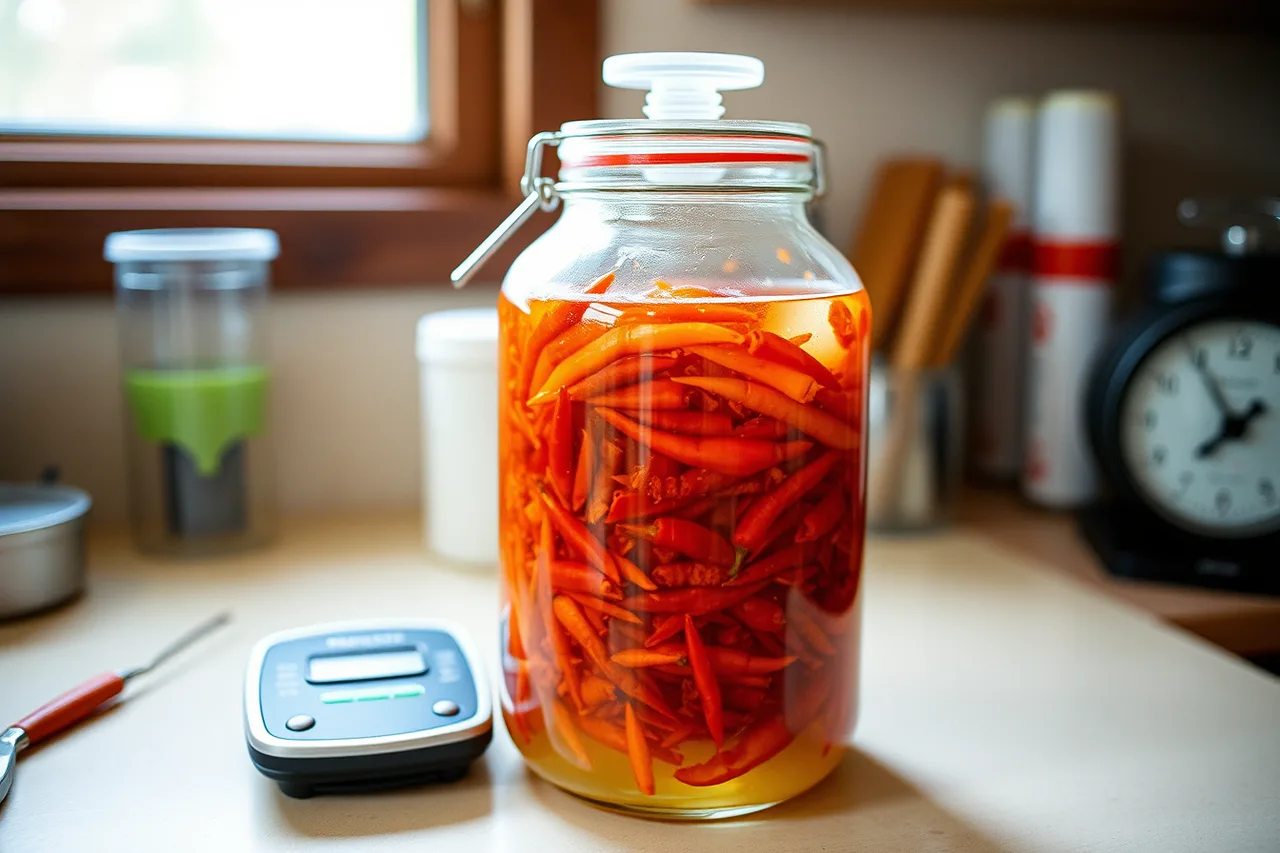
The reason is acidity and preservation. A fruit jam is cooked to a high sugar level and sealed hot, so it is treated as low risk. A fermented pepper mash or a blended fresh sauce sits in a different category because its safety depends on measured acidity, salt and storage.
Regulators call this an acidified food. The term covers sauces, dressings and condiments that rely on added acid to stop bacterial growth. Acidified foods fall under federal rules that most cottage food exemptions do not cover.
That creates the split that confuses new makers. A state may allow home-made jam and home-made salsa under the same statute, then exclude sauces that need refrigeration. Some states allow only shelf-stable sauces. Others ban home sauce sales outright.
Several states have widened their cottage food lists in recent years to include acidified and fermented products, provided the maker tests pH and completes a recognized acidified foods course. The rules vary enough that a recipe legal in Oregon may be illegal in New York.
Federal guidance is a useful starting point before you read state law. The federal small business resources at Small business | USAGov explain registration, tax and licensing basics that apply once you sell beyond a hobby.
A practical first step is to decide what your sauce actually is. A vinegar-based sauce, a fermented mash, a cooked tomato base and a pepper relish all fall into different regulatory buckets. Your state statute will name the bucket, not your recipe.
pH and water activity limits that decide whether a sauce qualifies
Two numbers decide whether most home sauces qualify: pH and water activity. pH measures acidity on a scale where lower is more acidic. Water activity, written aw, measures how much water is free for microbes to use.
The common threshold is pH 4.6 or below. At that level, Clostridium botulinum cannot grow, which is the main concern in sealed acidified foods. Many states require home sauce makers to prove the finished product sits at or under that line.
Water activity limits are less universal. Where a state sets one, 0.85 or below is the usual figure. A sauce can pass on pH and still fail on water activity if it is thick, low in acid or high in sugar.
Testing must be done on the finished, cooled product, not on the mash or the vinegar. A reading taken mid-cook tells you little. Take the sample from a sealed batch you intend to sell, and record the batch number.
A handheld pH meter typically costs $50 to $300, strips run $10 to $30, and a lab pH test on a submitted sample typically costs $10 to $50.
Accuracy matters because the margin is thin. A cheap strip can read a full point off near the 4.6 line, which is the difference between a legal sauce and a recalled one. The comparison at ph meter vs test strips covers which tools hold calibration well enough for repeated batches.
Some states accept a pH meter reading and a written procedure. Others want a process authority letter, which is a review by a qualified food scientist confirming your method reaches the required acidity. A process authority letter typically costs $500 to $2,500 and takes two to six weeks, depending on the reviewer and the complexity of your scheduled process.
Fermented sauces need extra care. Fermentation lowers pH over time, but the drop is uneven across a batch and depends on salt, temperature and time. A state that allows fermented cottage foods usually requires a documented fermentation plan and a final pH test.
If your sauce includes garlic in oil, fresh herbs packed in oil, or any low-acid ingredient held at room temperature, assume it will not qualify. Those combinations are the classic botulism risk and most statutes exclude them by name.
Selected states: sales caps, venues and labelling
The table below summarizes how selected states treat home sauce sales. Figures are caps or thresholds set in state statute or rule, and they change. Confirm current numbers with your state department of agriculture before you print labels. The full list of states is linked at the end of this section.
| State | Home sauce status | Typical annual sales cap | Statute or rule | Cap effective | Main permitted venues | Label note |
|---|---|---|---|---|---|---|
| California | Allowed if acidified and shelf stable, with a permit | Around $75,000 gross, tiered by permit class | Cal. Health & Safety Code §114365 et seq. | 2013, amended since | Direct to consumer, some retail | Cottage food disclaimer required |
| Texas | Allowed for acidified sauces under cottage food rules | $50,000 gross | Tex. Health & Safety Code ch. 437 | 2013 | Farmers markets, farm stands, online in state | Disclaimer and ingredients required |
| Louisiana | Limited; acidified sauces need review | Low cap, varies by parish health unit | Louisiana Sanitary Code Title 51 | Varies by parish | Direct sales, some markets | State disclaimer required |
| New York | Allowed for some acidified products with home processing license | $50,000 gross | 1 NYCRR Part 276 | See current rule | Direct and some retail | Disclaimer and allergen statement |
| Oregon | Allowed for acidified and fermented sauces with testing | $50,000 gross | ORS 616.695 to 616.699 | 2011, amended | Direct, markets, some retail | Disclaimer required |
| Florida | Allowed for acidified sauces under cottage food law | $250,000 gross | Fla. Stat. §500.80 | 2021 | Direct, markets, online | Disclaimer required |
| Illinois | Allowed for acidified sauces with training | $25,000 gross | 410 ILCS 625 | 2012 | Farmers markets and direct | Disclaimer required |
| Washington | Allowed for acidified sauces with permit | $25,000 gross | RCW 69.22 | 2012 | Direct and markets | Disclaimer required |
Citations above are the current public references; section numbers and effective dates change with amendments. Confirm the current text with your state department of agriculture.
Caps count gross sales, not profit. Once you cross the line, the exemption ends for the rest of the year in most states. Some states count only sales of cottage food products, so other income does not push you over.
Venue rules are stricter than many makers expect. A sauce legal at a farmers market may be illegal to ship out of state or to place in a grocery. Retail placement usually triggers a licensed kitchen requirement regardless of your sales total.
Online sales are the fastest-changing area. Some states allow in-state shipping only. Others allow nationwide shipping of shelf-stable cottage foods. A few prohibit online sales entirely, even when market sales are fine.
Label rules follow a pattern. The product name, ingredient list in descending order by weight, net quantity, your business name and address, and a statement that the product was made in a home kitchen not inspected by the state. Allergen labeling follows federal rules for the major allergens.
Some states also require the county or state permit number on the label. A few require the pH of the finished product to be recorded but not printed. Health claims are not allowed on cottage food labels in any state.
A full state-by-state list of which states permit home sauce sales sits at us cottage food laws hot sauce. Use it as a map, then read your own statute, because the details differ at county level too.
Where home production stops and a licensed kitchen must begin
The exemption ends at a defined point. Cross it and you are a food manufacturer, subject to facility registration, inspection and the full acidified foods rule.
Four triggers end the exemption.
The first is the sales cap: annual gross revenue from cottage food sales. Exceed it and production must move to a licensed facility.
The second is venue: selling to a retailer, distributor or restaurant moves you out of cottage food in nearly every state, even below the cap.
The third is product type: a sauce that needs refrigeration, contains a low-acid ingredient, or fails the pH test does not qualify at any sales level.
The fourth is interstate commerce: shipping across state lines generally ends the exemption, because the exemption is a state rule and does not travel.
Once you cross any trigger, the requirements stack up. You need a licensed commercial kitchen or a co-packer, a food facility registration with the FDA, a documented food safety plan, and in most cases a process authority review of your scheduled process.
A licensed kitchen can be rented by the hour, shared with other producers, or replaced by a co-packer who makes and jars the sauce for you. Co-packing costs more per unit but removes the capital cost of equipment.
A co-packer typically requires a minimum run of 500 to 2,000 units, charges $2 to $6 per unit at that volume, and adds setup fees of $500 to $2,000.
Planning the move before you hit the cap saves money. The sequence from recipe to sellable batch is set out in small batch sauce production planning, including how to test price points before you commit to a facility.
State departments of agriculture issue the food processing licenses that replace the cottage food exemption. The application usually asks for your process, your equipment list, your water source and your label proof.
Permits, food handler certification and farmers market rules
Even under a cottage food exemption you will need paperwork. The exact list depends on the state and the market, but the pattern is consistent.
- Register your business with the state and get any local business license the city requires.
- Complete a recognized food handler course, usually ServSafe or a state-approved equivalent, and keep the certificate.
- Apply for the cottage food permit or registration with your state department of agriculture or county health department.
- Get the market's own vendor permit, which is separate from the state permit and often requires insurance.
- Submit your label for review if the state requires it, and keep the approved version on file.
Food handler certification is the most common requirement. Most states accept an online course followed by an exam, and the certificate is valid for a set number of years. Some states require the acidified foods course instead, which is longer and more technical.
Farmers market permits are local. A market may require a vendor application, proof of liability insurance, a health department permit, and a booth fee. Some markets limit the number of sauce vendors, so apply early.
California is a useful example because market rules vary by county and by market association. The permit path is described at california farmers market hot sauce permit, including what county health departments ask for.
Selling at a market also means sales tax. Most states tax prepared food but exempt staple groceries, and sauce sits in between. Register with the state sales tax authority and file returns even in months when you owe nothing.
If you plan to sell at events in more than one state, check each state's rules separately. A permit from your home state does not authorize sales elsewhere, and some states require a temporary food permit for each event.
Insurance, testing and recordkeeping a home producer still owes
A cottage food exemption removes the kitchen license, not the risk. If someone gets ill from your sauce, you are still the producer.
Product liability insurance is the main protection. Many markets require a certificate naming the market as additional insured before they will give you a booth. The options for small sauce makers are set out at liability insurance for hot sauce makers, including per-occurrence limits and what policies exclude.
Testing is an ongoing cost, not a one-time step. Each batch or each recipe change needs a pH reading, and some states require periodic lab verification. Keep the meter calibrated and log the readings.
Recordkeeping is what saves you in an inspection or a complaint. Keep batch numbers, pH readings, ingredient lot codes, production dates, and where each batch was sold.
Retention periods vary. A common requirement is two years for production records and the same for distribution records. Store them somewhere dry and backed up, not on a phone that gets replaced.
Barcodes become relevant when you move to retail. GS1 US issues the UPC prefixes that retailers scan, and a co-packer or distributor will ask for them. Cottage food sales direct to consumers usually do not need a barcode.
Organic claims add another layer. USDA organic certification requires certified ingredients and a certified handler, and a home kitchen is rarely eligible. If you want an organic claim, plan for it before you scale.
Reading your own state statute before you scale
No summary replaces the statute. Cottage food rules are written in state code, and the code is where the cap, the pH limit, the label text and the venue list actually live.
Start with your state department of agriculture website. Search for cottage food, home food processing or acidified foods. Read the definition section first, because it tells you whether sauce is included.
Then read the exemptions. The exemption is the part that lets you operate from home, and it lists the conditions you must meet. If your product does not match the definition, the exemption does not apply.
Check the cap and the venue list against your plan. If you intend to sell online, wholesale or across state lines, find the sentence that addresses it. If the statute is silent, ask the department in writing and keep the reply.
Free help exists. The local assistance offices listed by the Local assistance - Small Business Administration can point you to the right state office for your region.
Business advisers at Resource Partners - Small Business Administration include Small Business Development Centers and SCORE mentors who work with food businesses on state rules, licensing and pricing.
If you are still at the idea stage, the federal guide at How to start and fund your own business | USAGov covers registration, funding and the basic compliance steps that apply before your first sale.
Before you scale, work through this list. Each item is a question your state or market will ask.
- Does my state's cottage food law name acidified or fermented sauces as allowed products?
- Does my finished sauce test at pH 4.6 or below, and do I have a written procedure?
- Does my state also set a water activity limit, and does my sauce meet it?
- Am I under the annual sales cap, counting gross sales only?
- Are all my venues permitted under the statute, including online sales?
- Is my label complete, with the required home kitchen disclaimer and no health claims?
- Do I hold current food handler certification and a market vendor permit?
- Do I have product liability insurance and a batch record system in place?
Two neighboring states can differ sharply on the same recipe, which is why makers who sell across a border often need two plans. The differences between two major sauce states, Texas and Louisiana, are compared at texas vs louisiana hot sauce.
Read the statute once a year. Caps rise, product lists expand, and label wording changes. A rule that blocked your sauce last year may allow it now, or the reverse.