Reviews
Part of American spice blends by style family: five value criteria and enforceable label claims
Two American spice blends, compared dose for dose at your own kitchen table
Baltimore-style and Cajun blends, weighed gram for gram, salt-corrected and blind-coded, so the tin you buy next is the one you actually prefer.
What to take away
- Two American spice blends belong on the same scale, compared dose for dose at your own kitchen table: Baltimore-style seafood seasoning (Old Bay, J.O. No. 1) and Cajun seasoning (Tony Chachere's Original, Slap Ya Mama Original).
- Weigh equal doses in grams. A teaspoon of fine salt and a teaspoon of flake hold different weights, which kills the test before it starts.
- Salt decides most of these blends. Prepare a third sample of the less salty one, salted up to match, before you score anything.
- Score dry aroma before you cook. A musty note is a storage problem, not a recipe problem.
- Write down one sentence about where you would use each blend. That sentence outlasts the numbers.
The two blends on the table
Two American spice blends are worth weighing dose for dose at your own kitchen table: Baltimore-style seafood seasoning and Cajun seasoning. Both start with salt and build on one loud second note, so the comparison is fair.
Baltimore-style seafood seasoning is the celery-salt blend built for steamed blue crabs and shrimp. Old Bay, made by McCormick, is the tin most people picture. Celery salt leads its ingredient list, and a 6 ounce tin typically sells for $4 to $7.
J.O. Spice Company in Halethorpe, Maryland sells its own crab seasoning, No. 1, ground for shrimp, crab and fried fish. Smaller Maryland packers sell their own versions too.
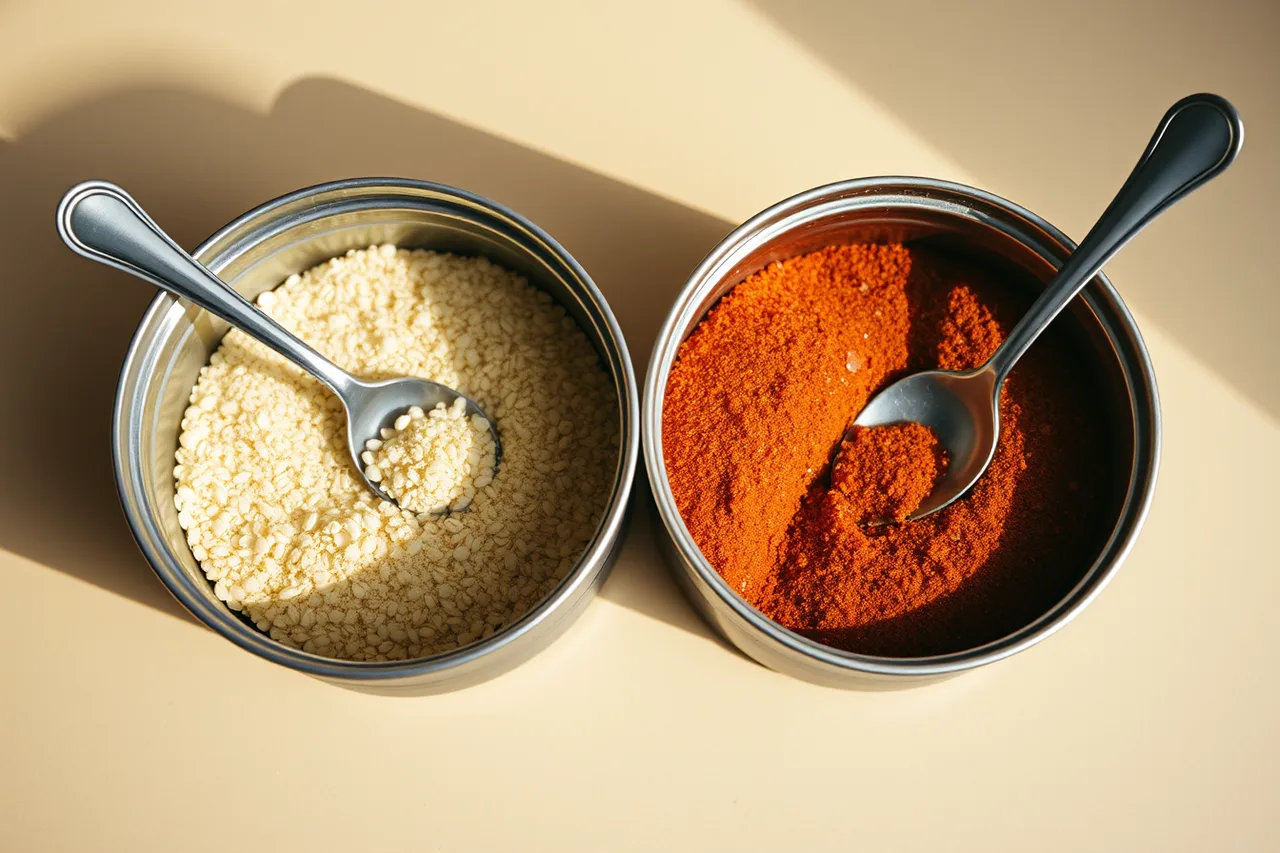
Cajun seasoning is the Louisiana blend: paprika and cayenne up front, then garlic, onion and black pepper. Salt holds it together.
Tony Chachere's Original Creole Seasoning, from Opelousas, Louisiana, is the grocery-shelf standard. Tony Chachere first sold the blend in 1972, and an 8 ounce shaker typically costs $3 to $5.
Slap Ya Mama Original Blend, made by Walker & Sons in Ville Platte, Louisiana, is the other tin you find almost anywhere. Zatarain's Creole Seasoning, from New Orleans and owned by McCormick, sits on the same shelf.
They belong in the same test because they share a structure. Salt first, celery seed or cayenne second, then the supporting spices. Comparing either against a salt-free Greek blend measures your mood, not the products.
Set up the comparison
You need a gram scale, two identical skillets or pots, a neutral carrier like plain rice or unsalted butter, and a second person to code the samples. Weigh the same dose of each blend.
Then read the ingredient lists. Ingredients run in descending order by weight, so the position of salt tells you what you are dealing with. what that single line reveals about a blend is worth more than the front panel.
Prepare a third sample: the less salty blend with salt added to match the other. Three coded samples tell you whether you preferred the blend or the salt.
The measurement discipline behind it
Consistency is a measurement problem before it is a cooking problem. NIST's fundamentals of metrology seminar covers units, good laboratory practice, data integrity and measurement uncertainty.
The transferable lesson is short. Fix your units, record what you did, repeat the measurement, and treat one reading as provisional.
In practice: weigh in grams, cook both samples at once in the same oven, and repeat the whole comparison on a second day before concluding anything.
What to score and which blend wins
Field / What to look for
- Aroma dry
- Freshness, dustiness, any musty note
- Aroma cooked
- What appears only with heat
- Salt
- Whether it dominates
- Heat
- When it arrives and how long it lasts
- Texture
- Grind size and how evenly it coats
- Finish
- What is still there after thirty seconds
Score dry aroma first, while your nose is fresh. Aroma fades from attention faster than taste, so starting with cooked samples underrates the more aromatic blend.
At matched salt and equal grams, the Cajun blends win heat and finish. Tony Chachere's and Slap Ya Mama put red pepper and garlic forward, so the burn arrives early and outlasts thirty seconds.
The Baltimore-style blends win aroma and texture. Old Bay and J.O. No. 1 coat rice and shrimp evenly and lead with celery seed, which the Cajun tins do not carry.
For steamed crab, shrimp and a crab boil, the Baltimore-style tin wins. For rice, gumbo, grilled chicken and fries, the Cajun tin takes paprika and heat. That is the dose-for-dose verdict.
A faint or musty dry aroma is a storage verdict, not a formulation one. what moisture, heat, light and oxygen do to a jar explains most of the gap between two tins of the same blend.
Checking the claims on the tin
If a blend makes a health or composition claim, check it. The National Agricultural Library's guide to finding nutrition research and publications lists curated search strings across PubAg and PubMed.
The same habit works on ordinary marketing claims. A tin that says its paprika is smoked over oak either names the process and the wood or it does not. A maker who confirms it in an email has told you more than the front label did.
Be careful in the other direction. Absence of research on a blend is not evidence against it, and a study on an isolated compound rarely says anything about a pinch on a dinner plate.
For the technique applied to one blend at a time, see our seasoning tasting method, and for the criteria that decide which blends are worth comparing, see the buyer comparison guide.
Common questions
How many blends per session?
Two, plus a salt-corrected control. Three samples is the practical limit for careful scoring, because your palate dulls and your notes get sloppy after that.
Do I need a scale?
Yes. Spoon measures of different grinds hold different weights, which invalidates the comparison. A gram scale costs less than one tin of the blends you are testing.
What if I cannot tell them apart?
That is a real result, not a failure. It usually means the cheaper one is the better buy, and it saves you the shelf space.
Should I taste them on plain food or a real dish?
Both, in that order. A blend can win on plain rice and lose on a plate of shrimp, because fat and acid change which notes come forward.
Which tin should I buy?
Match the salt first, then pick by use. Old Bay or J.O. No. 1 for steamed crab and shrimp, Tony Chachere's or Slap Ya Mama for rice, gumbo and grilled meat. Spice shops and grocery aisles carry all four.