Reviews
Part of How do you actually find indie sauce brands worth following on your own?
How to Judge Independent Sauce Brands by Comparing Two Lots of the Same Sauce
How to judge independent sauce brands: buy the same sauce twice months apart, weigh equal samples, compare labels and keep a record of what holds steady.
What to take away
- Independent sauce brands are not bottles. What separates one from another is whether the product holds still across lots.
- Buy the same bottle twice, months apart, and compare. That test tells you more than any tasting note.
- Weigh samples. A teaspoon of Red Boat fish sauce and a teaspoon of Torchbearer Garlic Reaper are not the same amount of anything.
- Read the two labels side by side while you taste. Half the explanation is printed on the bottle.
The test that ranks brands, not bottles
Buy a bottle. Note the lot code. Store a small sealed sample. Three to six months later, buy the same product again and compare the two blind, side by side. A brand whose product is indistinguishable across lots has process control. A brand that has drifted does not, whatever the second bottle tastes like alone.
The Lot-to-Lot Brand Test
- Day 0Buy bottle, note lot code
- Day 0Store small sealed sample
- 3-6 monthsBuy same product again
- LaterCompare both blind, side by side
- VerdictIndistinguishable = process control
Makers run that comparison on themselves, and the retained jar system behind it is what lets them trace a drift back to a particular run.
The test costs the price of two bottles, and it separates serious operations from enthusiastic ones more reliably than any panel. Two bottles of Yellowbird Habanero run about $12 to $14. Two bottles of Truff Black Truffle run about $36 to $40. The method is identical; only the entry fee changes.
Seven independent sauce brands, bottle by bottle
Same test, seven different bottles. What changes is bottle size, price, where the sauce is made, and what the label lets you check. Prices are typical US retail in 2026 and move with the store.
Seven independent sauce brands
| Bottle | Made in | Typical price | What the two-lot test is looking for |
|---|---|---|---|
| Secret Aardvark Habanero Hot Sauce, 8 oz | Portland, Oregon | $8 to $10 | Tomato and carrot base; whether heat and texture match at equal mass |
| Yellowbird Habanero Condiment, 9.8 oz squeeze bottle | Austin, Texas | $5 to $7 | Carrot and lime balance; whether the cap dispenses the same amount |
| Marie Sharp's Habanero Pepper Sauce, 10 oz | Dangriga, Belize | $6 to $9 | Color and heat across lots; peppers come from the company's own farm |
| Truff Black Truffle Hot Sauce, 6 oz | Los Angeles, California | $18 to $20 | Truff aroma and sweetness; a truffle slice sits inside the bottle |
| Torchbearer Garlic Reaper, 5 oz | Mechanicsburg, Pennsylvania | $15 to $20 | Very high heat; weigh 2 g to 3 g samples so both can be tasted |
| Queen Majesty Scotch Bonnet and Ginger, 5 oz | Brooklyn, New York | $12 to $14 | Small batches; vinegar sharpness and ginger bite |
| Red Boat 40N Fish Sauce, 250 ml | Phu Quoc, Vietnam | $10 to $13 | First press, barrel aged; salt and protein level at the same bottle size |
Start with one product per brand and hold the rest of the rack back. A verdict on a brand needs two lots of one bottle, not one bottle from each of five brands. Several brands side by side is a different job, and it answers a different question.
Weighing, and why volume fails
Sauces differ in density and viscosity, so a teaspoon of a thick paste and a teaspoon of a thin sauce are not the same amount of anything. Weigh each sample to the same mass. The same scale settles the other argument about small batch sauces, which is how much of a concentrated bottle actually belongs on a plate.
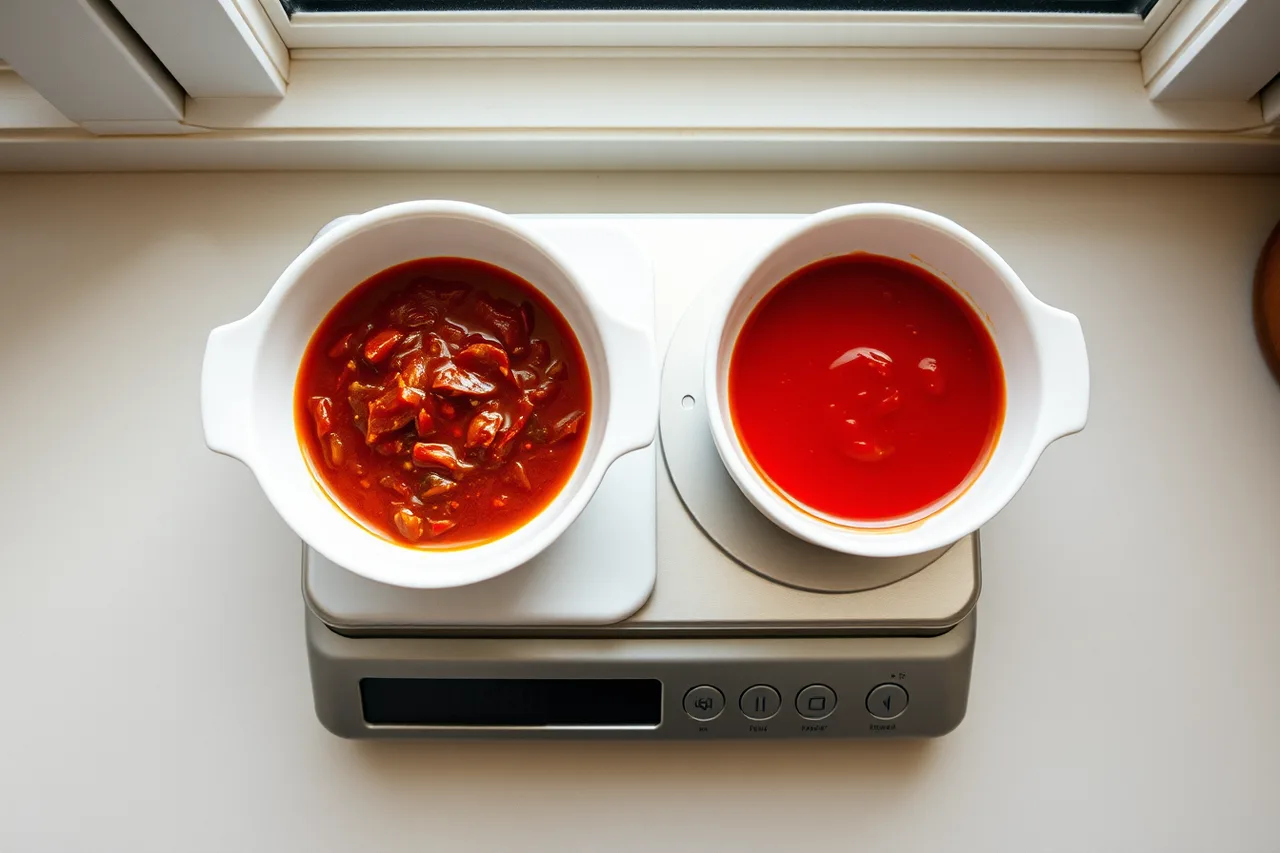
NIST runs a seminar on balance and scale calibration and uncertainties. It covers sources of weighing error, selection of reference standards, and uncertainty budgets, with much of the time spent on hands on calibration.
Nobody needs that depth for a kitchen comparison. What transfers is the habit: know your instrument's limits, check it against a known mass occasionally, and record what you measured.
Temperature and container matter as much as mass. Serve both samples at the same temperature in identical white dishes. Color differences read as quality differences, and a warm sample smells stronger than a cold one.
If one bottle has been open for a month and the other opened this morning, you are comparing storage, not brands. Open both fresh or age both equally.
Read the labels together
Put the two bottles next to each other and compare the labels line by line before you form an opinion. Ingredient order, presence of thickeners, declared quantity, storage instruction and any certification tell you why the two products behave differently.
The National Agricultural Library's page on food labeling collects the relevant legislation and guidance in one place, including the Fair Packaging and Labeling Act, allergen labeling law, quality labels and bioengineered disclosure. Knowing which parts of a label are required and which are voluntary changes how you read the front panel.
Both bottles in a consistency test should be the same product, so the two lists should match line for line. When they do not, the formula moved, and the front panel rarely announces it.
| Compare | What the difference tells you |
|---|---|
| Ingredient order | Where the money went in the formula |
| Thickeners present | Body built rather than reduced |
| Declared quantity | The real basis for price per ounce |
| Storage instruction | How the product was stabilized |
| Lot code format | Whether records exist |
| Named variety | Whether the maker can source the same pepper or fish twice |
Keep the record
One comparison is an anecdote. A folder of them, with lot codes and dates, is a genuine view of which brands hold their quality. Note the date, the lot, the source, and one sentence on the result.
Six comparisons across a year will change how you shop. You will start buying from the brands that hold steady rather than the ones that impressed you once.
The general tasting technique is in our tasting flight guide, and the brand level signals worth tracking are in the watch list guide.