
Reviews
Part of Small batch sauce production planning: five steps, in order
One production-tasting checklist that catches sauce drift before customers do
Setting up production tasting that catches drift: retained reference jars, blind triangle tests, a fixed vocabulary and records that survive staff turnover.
What to take away
- Tasting your own product is quality control, not enjoyment. Structure it or it tells you nothing.
- Keep a retained jar from every lot. Without a reference, you cannot detect drift.
- Blind comparison against the reference beats scoring a batch on its own.
- Write the result down the same day, in the same fields, in a book that outlives whoever tasted it.
Why unstructured tasting fails
You made it, so you expect it, and expectation is the strongest bias in sensory work, and worse for the recipe's author. A maker tasting a fresh batch will usually confirm it is correct, because the brain treats a familiar stimulus that way.
So drift stays invisible until a customer names it, by which point several lots have shipped.
The fix is comparison. Never score a batch alone. Score it against something. Repeat measurement is the other half, and the session controls that keep a palate honest from one day to the next apply as much to a production panel as to a shelf comparison.
The reference jar system
Pull two jars from every lot and label them with the lot code and fill date. One is your reference for the next production run. One is the retained sample you keep for the life of the product, so you can taste it if a complaint arrives.
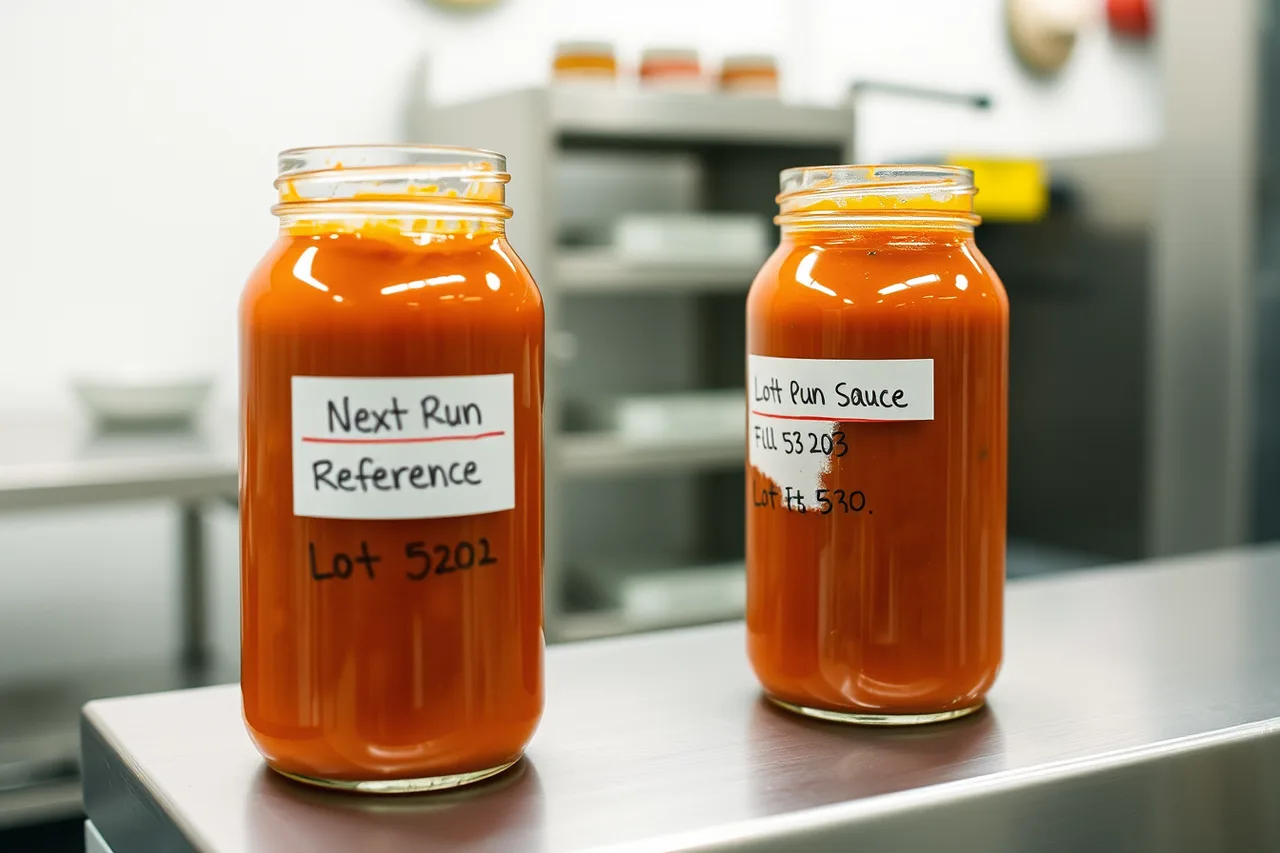
Store references the way a customer would store the product, not the way a laboratory would. If the label says refrigerate after opening, you learn nothing from an unopened jar kept cold.
Running a comparison that means something
- Present the new batch and the reference in identical containers, coded, not labeled.
- Use three samples where two are the same and one differs, and ask the taster to find the odd one. If nobody can, the batches match.
- Score in fixed fields: aroma, acidity, salt, heat, body, finish, and a single pass or fail.
- Use at least three tasters where you can, and never let them talk before scoring.
- Repeat the panel at the same time of day, since palate sensitivity shifts across a shift.
The same coding discipline works on the buying side of a shelf, where comparing two products of one style collapses the moment one of them is saltier and nobody corrects for it.
Formal interlaboratory work uses the same logic at a much higher level of rigour. NIST runs a proficiency testing service in which laboratories measure common artefacts and compare results, precisely because a single laboratory scoring its own work cannot see its own bias. A three person tasting panel is the small kitchen version of the same idea.
Building a shared vocabulary
A panel that says a batch tastes off produces no action. A panel that says the acid arrives later and the finish is shorter tells the cook what to check. Agree on ten terms, write definitions next to them, and stop using anything else on the score card.
Composition data helps here. USDA's food composition resources cover macronutrients, micronutrients, phytonutrients and sweeteners, which is useful when you need to explain why a substitution changed body or sweetness rather than only noting that it did.
Keep the vocabulary physical. Terms like bright, clean and balanced feel meaningful but cannot be acted on, while sharper on the first taste, thinner body, or bitter finish point to a specific stage of the process.
When a term keeps appearing on score cards, write down which process variable it maps to. The panel slowly becomes a diagnostic tool rather than a preference survey.
Then connect the panel to the process. If a lot fails, the record should let you find the batch sheet, the ingredient lots and the person who ran it. That chain is described in the planning sequence, and the consumer facing version of structured tasting is in our tasting flight guide.