Reviews
Part of 4 things to understand about specialty seasoning ideas
Specialty seasoning ideas: pairing ideas that work
Specialty seasoning ideas and pairing ideas built on bridge, contrast and echo, plus when to add the blend and how to record a pairing that works.
A blend earns its place only when the pairing works on the plate. The specialty seasoning ideas and pairing ideas here are the three that hold up — bridge, contrast and echo — along with the moment each one belongs to and a way to write the result down so it can be repeated.
What to take away
- Pair through a bridge ingredient. Two things that share an aroma family usually work together.
- Timing matters as much as choice. Some blends belong in the pan, others only at the end.
- Fat, acid and salt are the carriers. A pairing that fails often fails because one of the three is missing.
- Write pairings down as ratios and moments, not as adjectives, or they cannot be repeated.
Three ways to build a pairing
- Bridge. Find a shared note. Coriander seed and orange share a citrus character, so a blend built on coriander lands easily on anything cooked with orange. Za'atar and sumac share the same tart, herbal note, so za'atar over labneh or grilled chicken that already carries sumac reads as one idea rather than two.
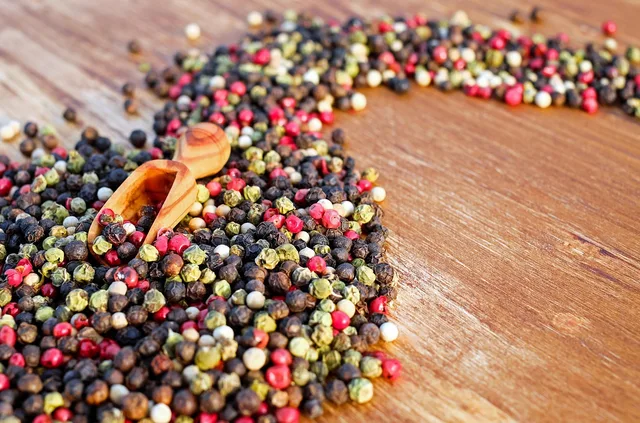
- Contrast. Set a sharp blend against a fatty base. Green peppercorn against butter or oily fish works because the fat softens the edge and the blend cuts the richness. Harissa against roasted carrots and shichimi togarashi over a bowl of udon do the same job.
- Echo. Repeat the ingredient in two forms. Smoked chilli in the rub and fresh chilli in the garnish reads as depth rather than repetition. Garam masala in the pan and the same blend at the table does it in a lentil dish.
Each of these is testable in ten minutes with a spoon of yoghurt or a piece of plain potato. Do the test before you write a recipe. Yoghurt and potato are two of the carriers a blend has to be tasted through before it is judged at all, so the test doubles as a check on the blend itself.
Three Pairing Methods
Bridge
- Mechanism
- Shared note
- Example
- Coriander + orange
- Test carrier
- Yoghurt
- Result
- Lands easily
Contrast
- Mechanism
- Sharp vs fatty
- Example
- Green peppercorn + butter
- Test carrier
- Oily fish
- Result
- Fat softens edge
Echo
- Mechanism
- Same ingredient twice
- Example
- Smoked + fresh chilli
- Test carrier
- Plain potato
- Result
- Reads as depth
Specialty seasonings and the pairings that work
- Za'atar.A thyme, sesame and sumac blend from the eastern Mediterranean. It belongs on labneh, flatbread and olive oil, and it works on roast chicken.
- Sumac.Dried, ground berries with a tart, red bite. Toss it with sliced onion and tomato, or dust it over grilled meat and fish.
- Harissa.A North African chilli paste with garlic, caraway and coriander. Stir it into roasted carrots, eggs or lamb.
- Shichimi togarashi.A Japanese chilli blend with sesame, orange peel and nori. Sprinkle it over udon, rice or grilled skewers.
- Garam masala.A warm South Asian blend of cumin, coriander, cardamom and cinnamon. Stir it into lentils and root vegetables, or add it at the end of a braise.
- Chermoula.A Moroccan marinade of herbs, garlic, cumin and lemon. Spoon it over fish or roasted vegetables.
Blends in this style come from independent spice houses rather than the supermarket shelf, and Penzeys Spices and Burlap & Barrel are two of the better known in the US. Those are the jars worth the shelf space ahead of a generic all-purpose mix.
When the blend goes in
| Moment | Suits |
|---|---|
| Marinade, hours ahead | Salt led rubs, cure blends, whole seed mixes |
| In the pan with fat | Ground spices that need heat to open |
| Late in the cook | Delicate herbs and citrus peel |
| At the table | Finishing salts and anything with fresh aroma |
Putting a finishing blend into a long braise is the most common pairing mistake there is. The aromatic compounds leave, the salt stays, and the result reads as flat and over seasoned at the same time.
When the Blend Goes In
- Marinade, hours aheadSalt led rubs, cure blends, whole seed mixes
- In the pan with fatGround spices that need heat to open
- Late in the cookDelicate herbs and citrus peel
- At the tableFinishing salts and anything with fresh aroma
What else moves a pairing: produce and sweeteners
Vegetables are where a small produce change alters the pairing. Ripeness, variety and processing shift sweetness and water content.
USDA publishes grade standards for a long list of vegetables and processed vegetable products, from peppers and onions to pickles, sauerkraut and chili sauce. Reading a standard quickly teaches how professionals describe color, uniformity and defects, and that vocabulary makes pairing notes more useful than saying a combination tasted good.
USDA's overview of sweeteners distinguishes nutritive sweeteners that provide calories from non nutritive options used to reduce added sugars, and the two behave very differently in a blend.
Sugar browns, carries heat and balances acid. A non nutritive sweetener does none of those things, so swapping one for the other changes the pairing rather than only the nutrition panel.
Why some pairings collapse instead of layering
Some combinations fail for structural reasons rather than taste. A high sugar blend on anything that spends a long time over direct heat burns before the food is cooked. A low sugar version built for hot and fast cooking is one of the variations worth testing against the original rather than a compromise.
A delicate herb blend in a pressure cooker loses its aromatics entirely. Whole seeds on a thin cut of fish give an unpleasant texture contrast that no seasoning skill fixes. And two strongly aromatic blends in the same dish do not layer, they cancel, leaving a muddled result that tasters call busy without being able to name the cause.
Recording a pairing so it survives
Write the blend, the dose in grams per portion, when it was added, the fat present, and the acid present. Then write one sentence on what it fixed.
A worked note reads like this: za'atar over labneh, added at the table, olive oil as the fat, lemon as the acid, and it fixed a flat, under-seasoned plate. Written that way, anyone can repeat it.
This format lets someone else reproduce the result and find the pattern across twenty notes. Our condiment flight guide lays out a tasting structure that works for blends with only small changes, and more blends are cataloged in the seasoning ideas list.